












Μετάφραση 
Psaromyta Lighthouse
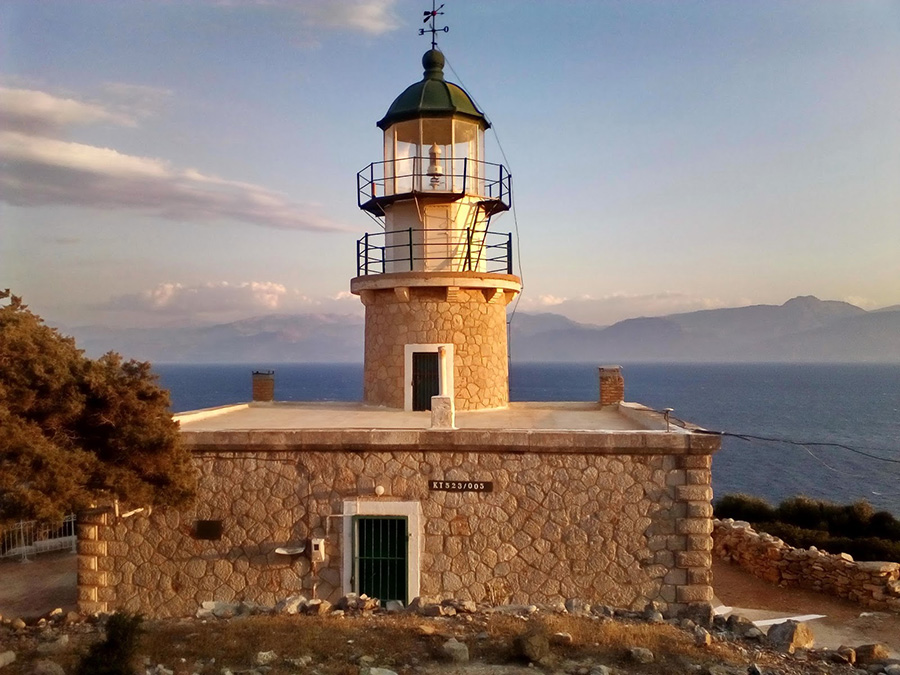
The Psaromyta Lighthouse first began operating in 1894, originally powered by oil. Its early light signature was a single white flash every 30 seconds, visible from 12 nautical miles. During World War II the lighthouse was deactivated, but it reopened in 1945 as part of Greece’s lighthouse network reconstruction. In 1982 it was fully electrified, replacing its oil mechanisms and adopting a new characteristic of two white flashes every 15 seconds, now visible from 21 nautical miles.
Architecture & Structure
The lighthouse complex consists of a single-storey keeper’s house of about 100 m² with three bedrooms, a kitchen, and a central corridor. The tower itself is a 9-metre-tall round concrete structure with a 1-metre wall thickness and an internal staircase connecting directly to the house. Beside it stands an auxiliary building that once served as a storage room, toilet, and oven. Renovations and improvements were carried out in 1930 and 1945.
Location & Surroundings
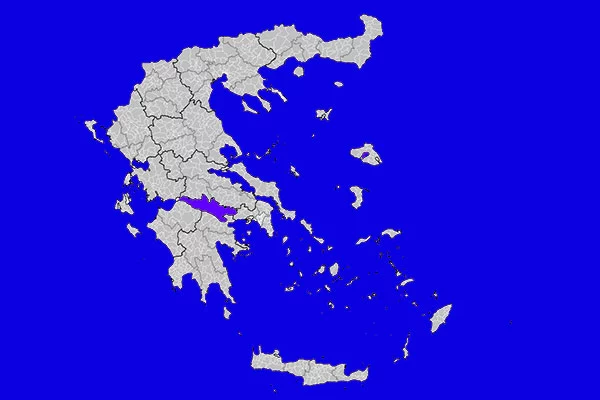
Located in Central Greece, Psaromyta is one of only six lighthouses along the Corinthian Gulf. Its focal height is 65 metres, offering wide, unobstructed views of the Peloponnese mountains across the water. The site is enclosed by metal railings and has a concrete courtyard, so visitors with young children should supervise them closely.
During summer, scorpions have occasionally been spotted in the surrounding area, so caution is advised. A visit to the lighthouse pairs perfectly with a swim at Vathi Beach, a beautiful pebble shore just 3 km away.
Access
Access to the lighthouse is via a roughly 2 km dirt road branching off the Antirrio–Itea national road, between the villages of Agios Nikolaos (4 km) and Erateini (6 km). A sign marks the turnoff for Cape Psaromyta and the lighthouse.
The dirt road is in poor condition, and travelling with a regular car is not recommended. A vehicle with higher clearance (SUV/4×4) is strongly advised.
