Halkidiki
Mount Athos
Stavronikita Monastery, ranked 15th among the monastic institutions of Mount Athos, is perched on a rocky cliff 50 meters above the eastern coast of Athos. It celebrates its feast day on December 6th in honor of Saint Nicholas.
The monastery's origins are shrouded in mystery, with multiple theories regarding its foundation. The most plausible suggests that its name derives from the monks Stavros and Nikitas. Historical records first mention Stavronikita as a monastic cell in a document from 1012 by Protos Nikiforos, with another reference in 1153. The monastery’s history remains unclear for several centuries until 1533, when it was initially under the control of Koutloumousiou and later Philotheou Monastery. During this period, it suffered attacks and looting by Crusaders.
In 1533, Gregory Ghyromeriatis purchased the monastery, fortified it with defensive walls, and initiated extensive construction. His work was later completed by Patriarch Jeremias I, who declared Stavronikita a patriarchal and stavropegic monastery. Today, both Gregory and Jeremias I are honored as co-founders of the monastery. Following a devastating fire in 1607, the monastery was rebuilt from the ground up.
The Katholikon (main church) was built in 1456 by Patriarch Jeremias and completed in 1546. That same year, the renowned Cretan School iconographer Theophanes adorned its interior with exceptional frescoes. One of the monastery’s most treasured artifacts is the 14th-century mosaic icon of Saint Nicholas “Stridas”, named after a miraculous event involving an embedded oyster shell (στρείδι).
The refectory, renovated in 1780, features remarkable frescoes also attributed to the Cretan School. Stavronikita Monastery includes six chapels, four monastic cells in Karyes, and 44 hermitages (kalyves) in the Kapsala region.
The monastery’s library houses 58 parchment manuscripts, including the precious Evangelistarium No. 46, two rare silk-bound codices, three parchment scrolls, and numerous printed volumes.
The sacristy contains an extraordinary collection of relics, liturgical objects, embroidered vestments, and icons. Among them is the gold-embroidered icon of Saint Nicholas, alongside several portable icons, with the Saint Nicholas "Stridas" icon standing out as the most revered.
GPS Coordinates: 40.26816, 24.27747
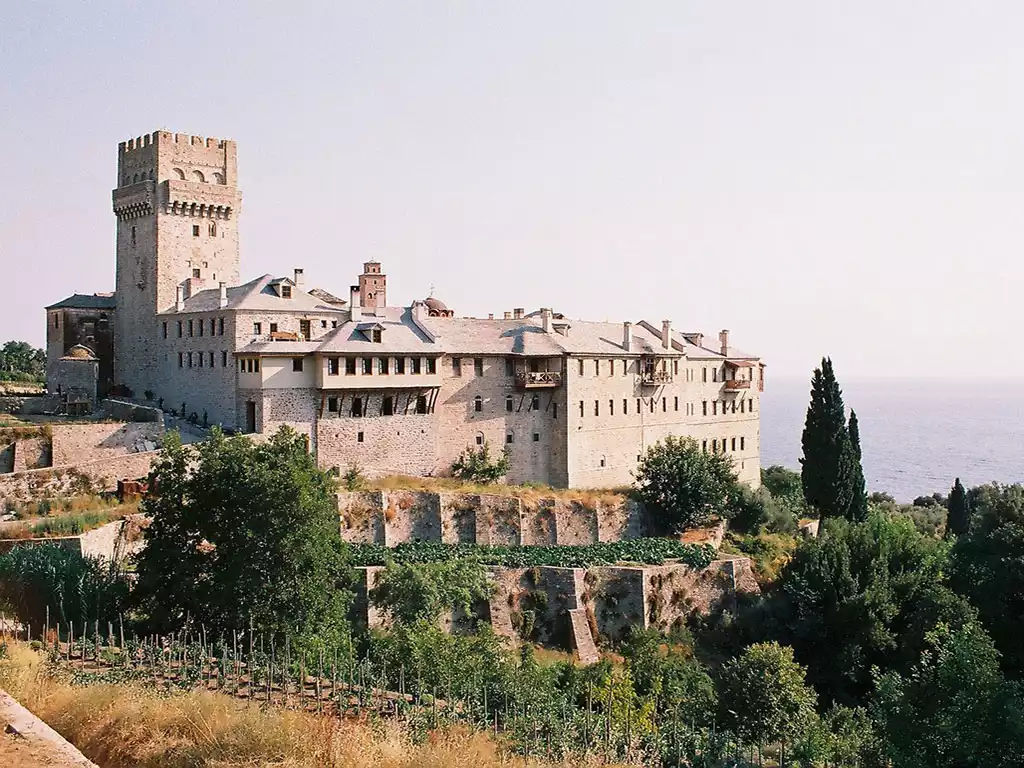 Karakallou Monastery
The Fortified Athonite Monastery with the Historic Tower
 Iviron Monastery
A Sacred Orthodox Pilgrimage Site with a Miraculous Icon
 Philotheou Monastery
The Athonite Monastery With the Miraculous Icons of Panagia
 Zografou Monastery
The Historic Bulgarian Athonite Monastery of St. George
 Docheiariou Monastery
The Coastal Athonite Monastery of Panagia Gorgoepikoos
 Konstamonitou Monastery
The Historic Athonite Monastery of Saint Stephen Protomartyr
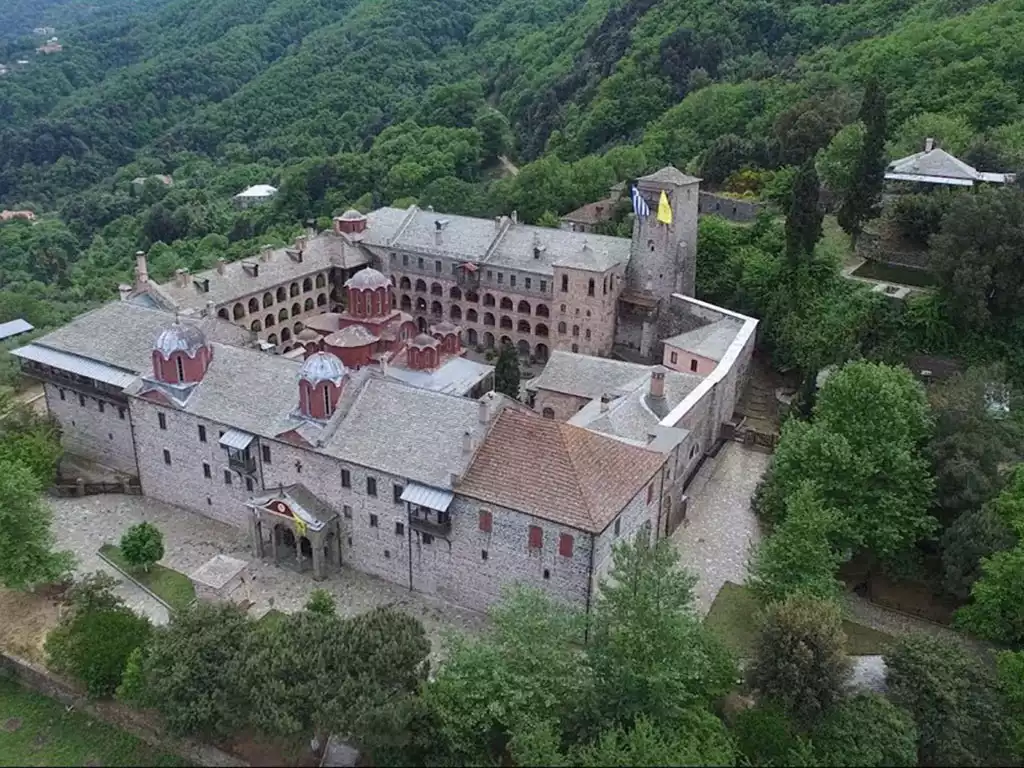 Koutloumousiou Monastery
Koutloumousiou Monastery at the Heart of Athos
Discover a curated selection of Greece’s top experiences, from festivals and sporting events to museums and hiking trails. Plan your next adventure and explore the best activities the country has to offer.