













Μετάφραση 
Lion of Amphipolis
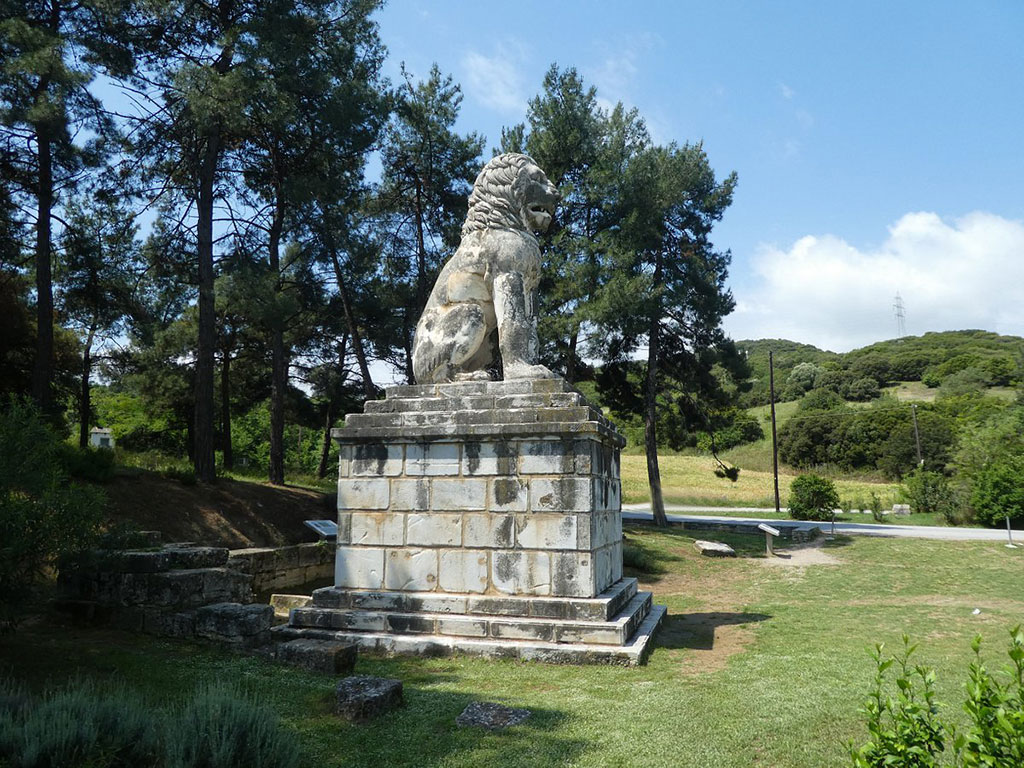
A fourth century BC funerary monument set up in honor of the admiral Laomedon from the island of Lesvos, a devoted companion of Alexander the Great, who was initially a trierarch (commander of a trireme) and in charge of prisoners of war before later serving as a satrap of Syria. The monument was restored on a conventional pedestal at the site where it was found. On the west bank of the Strymon River, near the old bridge.
The history of the monument’s discovery dates back to the 1912-1913 Balkan War, when Greek soldiers dug and discovered the foundation of its base and some parts of the lion’s body. The first archaeologists to become involved with excavating and studying the monument were Proffesors G. Oikonomou and A. Orlandos whose work was interrupted due to the war. Later, During WWI (1916), British soldiers camping in the region found parts of the lion’s body. A few years later, during installation works by the firm MONKS-ULEN (1930-1931) in the riverbed, new parts of the monument came to light. English and French archaeologists and technical experts began systematic investigation and study of the monument in 1932. Following manifold efforts and donations by Americans, French and Greeks, they arrived at the restoration of the monument done by Andreas Panayiotakis, the sculptor of the National Archaeological Museum.
According to J. Roger and O. Broneer, the original sculpture was made of limestone and consisted of a square base, surrounded by a colonnade of a Doric semi-columns, four on each side, supporting a Doric entablature. A stepped pyramid was set atop the entablature and atop this pyramid shaped base stood the huge lion. On the basis of this data, Broneer in his restoration, gave the monument the form of a mausoleum like the comparable funerary building of Asia Minor, believing that it was a monument to martial virtue set up to honor a noteworthy citizen of Amphipolis. Broneer date the monument to the last quarter of the fourth century BC.
The Lion Monument is not just a work of art which is imposing by virtue of its size and power. Apart from the rendering of anatomical details (veins, full mane, powerful muzzle, mouth pulled to one side, deep-set eyes) which intensifies the precision of the artist’s depiction of his subject, one is impressed by the symbolism of this sculptural work, which recalls the martial virtue and courage of Laomedon.
Source: Ministry of Culture
GPS Coordinates 40.80307, 23.84254