












Μετάφραση 
Ancient Agora of Thassos
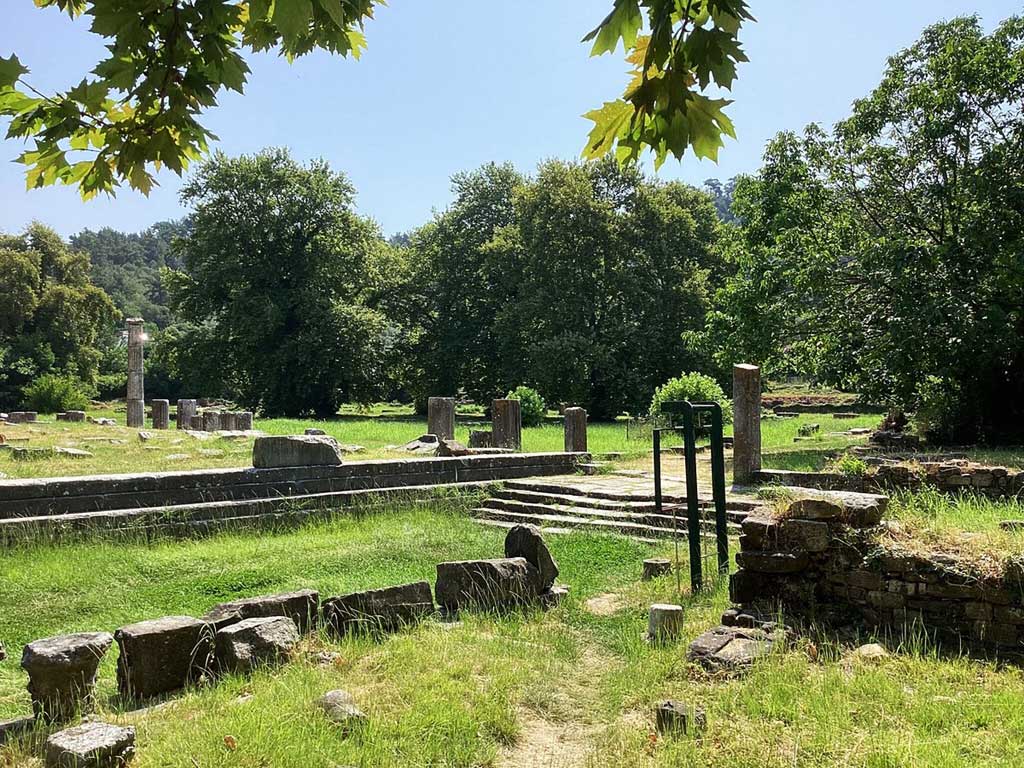
The Ancient Agora is a complex site with a multitude of temples and public buildings. In ancient Greece, the agora was the heart of a Greek city-state and the place where all aspects of communality took place, were performed and commemorated. The construction of the Ancient Agora in Thassos began in the 4th century BC and was completed in the 2nd century BC. For centuries, it served as the commercial, political and religious center of the island. The Ancient Agora covers an area of 12,650 square meters and will give you a small insight as to what life was like over 2000 years ago. The site was discovered in 1911 by a team of the French Archaeological School. This discovery led to new excavations between the years 1948 and 1955. The site is still under development, largely by the same school. Pottery and other veramics, as well as coins from the Classical era and the Roman era that were found during the excavations are now housed in the neighboring museum. Many reliefs and inscriptions found in the site, are also exhibited in the Louvre Museum in Paris.
The agora was a huge rectangular area that was lined with colonnades. These colonnades, standing in front of elongated halls (stoas), used to define structure and monumentalize the limits of squares and streets. The agora was surrounded by more than 120 columns on all four sides. The heart of the agora was decorated with statues and altars. To the north is the ancient temple of Dionysus that dates back to the 4th century BC. There is also a sanctuary dedicated to Poseidon with a circular wall surrounding a U-shaped altar. Moreover, a number of shrines contained in the agora, including one to “Zeus Agoraios Thassian” with a circular courtyard of marble columns, and the aforementioned one to the athlete Theogenes. Three gates of the ancient market ensured access to the ancient port.
The Ancient Agora is located next to the Archaeological Museum, and just back from the old harbor. Given that there are ancient ruins all over Limenas (Thassos Town), the Ancient Agora is a good place to start as it is quite a large site. There is a map and some explanation at the entrance but after that you are on your own somewhat. A good idea is to take a photo of the map, and refer to it as you go around the site. It is a restful place to walk around and wonder, but some parts are overgrown. Being so close to the town center makes for an easy visit, especially when combined with the Archaeological Museum. In conjunction with the lovely museum next door, this is just a great way to experience the island’s ancient past. Overall, it is well worth a visit, even for those who are only mildly interested in ancient sites. This Ancient Agora is free to enter and wander around. It is open most days but usually closes at around 3pm.