












1. Amorgos Chora
Chora of Amorgos is considered to be one of the most traditional and picturesque villages of all the Cycladic capitals. Chora of Amorgos is the island’s capital, with 397 inhabitants according to the census of 2011. It is located at an altitude of 350 meters above sea level, and its trademark is the Venetian fortress (Kastro) around which the village is built. It was constructed in the 13th century by Venetian lords, as protection against invasions by Saracen pirates. Today’s traditional village, with its white cubic houses, circles the fortress; the narrow-cobbled streets form a maze where beautiful snapshots await you at every corner.
Another characteristic of the Chora is a large number of domed churches and miniature chapels scattered around the village. The Chora started to be built in the early Byzantine years, to the north and east of the fortress, and is built in such a way as to make it “invisible” from the sea, another precaution against the aforementioned pirate raids. The fortress, which is 65 meters high, was fortified by the Ieremia and Gyzi brothers (1207) during Venetian rule, and this was followed by the village’s expansion southwards. After it was occupied by the Turks (1537), the Chora flourished, with many churches being renovated and more new ones being built.
The medieval houses appear to be embracing the Kastro, while the cobbled streets become narrower as they approach the fortress, and are occasionally covered by arches. The whitewashed chapel of Kyra Leousa (Our Lady of Mercy) was built inside the fortress more than 15 centuries ago and is perhaps the village’s oldest church. It has a vestibule and other pre-Christian elements. The “vorina” (northerly) neighborhood extends from this point up to Photodotis (the Glebe).
Chora has two village squares, the Lower Square, where the Holy Metropolis of Amorgos is located and the Upper Square. The Lower Square or Loza is Chora’s main, and very picturesque village square. The name Loza derives from the Latin “loggia” or market. The square is dominated by a large eucalyptus tree, and you will see the old seat of the Amorgos Commune to your left as you walk up the square. Traditional annual festivals take place in both the village squares, such as the Sotiros on August 6th and the Traditional Amorgean “pasteli” (sesame and honey sweet) feast. The Holy Metropolis is dedicated to the Assumption of the Virgin Mary and to Saint John the Theologian; it was renovated in 1689. The icon of Kyra Leousa from the fortress chapel, mentioned earlier, is housed there.
The main street in Chora is traditionally paved with stone slabs and numerous steps, and extends from the eastern to the western edge of the village, crisscrossed by even narrower alleys from north to south and vice versa. The lower neighborhood (western entrance to the Chora) is punctuated by Byzantine churches such as the one dedicated to Agii Pantes. This church was renovated in 1644 and contains holy relics from the late 17th and 18th centuries. The Archaeological Museum of Amorgos, housed in the Gavras Mansion (18th century), is well worth a visit.
Heading upwards, you will come to a small square that marks the beginning of the Apano Gitonia (upper neighborhood), with its elegant white houses. At this spot, you will have access to Hellenic Post Office. From here, if you head eastwards and towards the edge of the village, you will come across the “Embrostiada”. This is a series of arches housing the historical Roussos mansion (19th century). Take a right after the archway and the street will lead you to a different neighborhood, known as the “Troullos”. This neighborhood is characterized by two-storey homes with wooden doors. This neighborhood will also lead you to Chora’s windmills.
Protected Historical Monument - ΦΕΚ 618/Β/17-9-1965

2. Katapola
Katapola is located in the center of Amorgos, in a natural and well-protected bay and is one of the island’s two ports. It is divided into three distinct neighborhoods, Katapola on the left, Rahidi in the middle and Xilokeratidi on the right. On the hill above Katapola are the excavations of the ancient city of Minoa which are of great archaeological interest. Minoa was one of the three cities of ancient Amorgos.
According to archeological findings, the bay has been inhabited for over 6,000 years. It seems to have played an important role in the inhabitation of the island and in its cultural prosperity from the Late Stone Age at the end of the 4th millennium BC. and later, especially in the Early Bronze Age, in the 3rd millennium BC. On the hill south of Katapola there are traces of habitation from the 4th millennium BC. The village of Katapola began to develop after 1830. Till then the bay was a base of pirates, and therefore there were no permanent residents. Katapola gradually began to be inhabited by the Amorgian captains who significantly developed shipping from the end of the 18th century until about 1950.
Katapola is a beautiful settlement that has preserved its Cycladic architecture with whitewashed houses and cobbled narrow alleys. Among the main attractions, is the old fountain and the church of Panagia Katapoliani with its Venetian bell tower, in the courtyard of which there are columns and capitals. The church is believed to have been built on an ancient temple dedicated to Pythian Apollo. On both sides of Katapola there are many other remarkable churches such as Agios Panteleimonos, Agios Ioannis, Agios Anargyros and Panagia.
Katapola along with Aegialis are the most developed spots of Amorgos with many restaurants, hotels, tourist and commercial shops. Katapola is nowadays a modern tourist resort full of life, mainly during the summer months, that attracts thousands of tourists every year. Close to Katapola, there are many beaches of all kinds, that can be reached either on foot or by boat. Among them are Maltezi beach, Plakes, Agios Panteleimon as well as the Three Hierarchs located at the edge of Xyrokeratidi, below the church with the same name.
One of the most important events is the feast of Psimeni on the eve of the celebration of St. Panteleimon, an event that you should not miss.

3. Ormos or Gialos
Aegiali or Giali, as the locals call it, is located in a natural bay in the northern part of Amorgos. On the mountainsides of Aegiali are built three traditional villages: Lagada, Tholaria and Potamos.
Ormos or Gialos, Aegiali’s port, is a small settlement and one of the two ports of the island. It is the newest village of Amorgos, as the villages in the past were built inland, far from the sea due to the fear of pirate raids. Ormos with its whitewashed houses that stand next to each other, has become a tourist resort, attracting many visitors during the summer. At the edge of the port stands a windmill while a few meters further lie a lovely, sandy beach, one of the longest and more popular beaches of the island. The small village which is situated 15 km away from Chora, the island's capital, retains to this date its charming character.
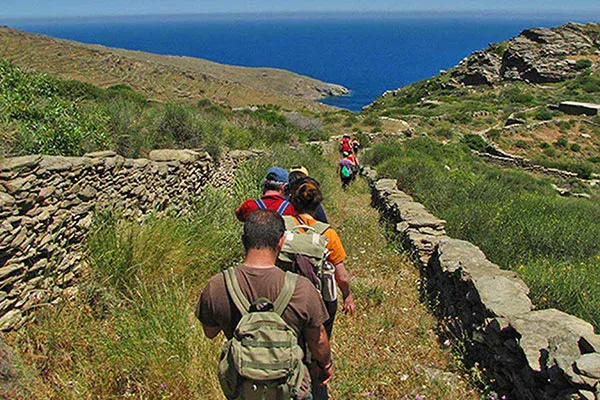
In Ormos, you can find hotels, studios, rooms to rent, tavernas serving delicious traditional food, cafes, bars as well as shops selling local products and souvenirs. From Ormos, it’s also easy to access a lot of walking paths with beautiful sceneries full of herbs and flowers that Amorgos is famous for.

4. Potamos Amorgos
Potamos is yet another of the traditional mountain villages of Amorgos. A quiet and very picturesque village that has kept the traditional architecture and way of life. Built amphitheatrically on the slopes of Sellada, over the bay of Aegiali or Giali as the locals call it, offers remarkable views over the archipelago and the bay of Aegiali as well as amazing sunsets over the Aegean Sea. The small village with the one and two-story houses with the whitewashed courtyards, the narrow alleys and the beautiful architecture enchants the visitors. It is actually two villages: the lower village is called Kato Potamos and the upper is called Ano Potamos. The two districts are connected by a paved path. In the village which is free of traffic you can find some tavernas, cafes and rooms to let.
The main attraction of the village is the church of the Ascension with its blue dome, which is also visible from the bay of Aegiali. Every year there is a big feast organized there where after the service and the procession of the icon around the village, visitors can taste traditional dishes of Amorgos, made by the women of the village.

5. Lagada Amorgos
Lagada or Langada is located in the north part of Amorgos on the edge of the Araklos canyon. The little village is surrounded by the highest mountains of the island, Krikellos which is 821 meters tall. Langada is a genuine Greek village with narrow alleys, traditional whitewashed houses, and small churches. The traditional customs exist in everyday life and you will get the opportunity to take part in Greek daily life. There are also many beautiful walking paths that are easy to access from the village. Near the village there are plenty of interesting places to visit such as the churches of Agia Triada and Panagia Epanochoriani, some old windmills, and the old settlement of Stroumbos. Moreover, in the area you can find the Byzantine monastery of Agios Ioannis Theologos near the mountain of Krikellos, and the church of Stavros.

6. Tholaria Amorgos
The traditional village of Tholaria is located 18 km north east of Chora, the island's capital, and 3 km away from Ormos. Surrounded by mountains crossed by several beautiful paths, the small village with the archways, the whitewashed houses and the narrow alleys, overlooks the bay of Aegiali and Kampos. The church of Agioi Anargyroi with the twin bell towers, dominates the heart of the village. It celebrates every year on July 1st, day on which a big feast is organized in the main square with traditional music, local dances and plenty of food and wine.
The church is surrounded by cafés and tavernas serving delicious homemade food. It is worth trying local rakomelo (a potent mixture of raki and honey) and fava (yellow lentil puree). In the evenings look out for live traditional music. The people of the village are engaged in agriculture and are well-known for their hospitality. Tholaria is an authentic Greek village, perfect to experience real Greek village life. Just outside the village is Vigla, the acropolis of the ancient city of Aegiali, an archaeological site worth a visit. Ask the locals to point out the footpath that will lead you to Mikri Vlychada beach. The beach emerges from the cliffs like an oasis and is famous for its crystal-clear waters. You can get there in just under thirty minutes’ walk.
