












Μετάφραση 
Didymoteicho Fortress
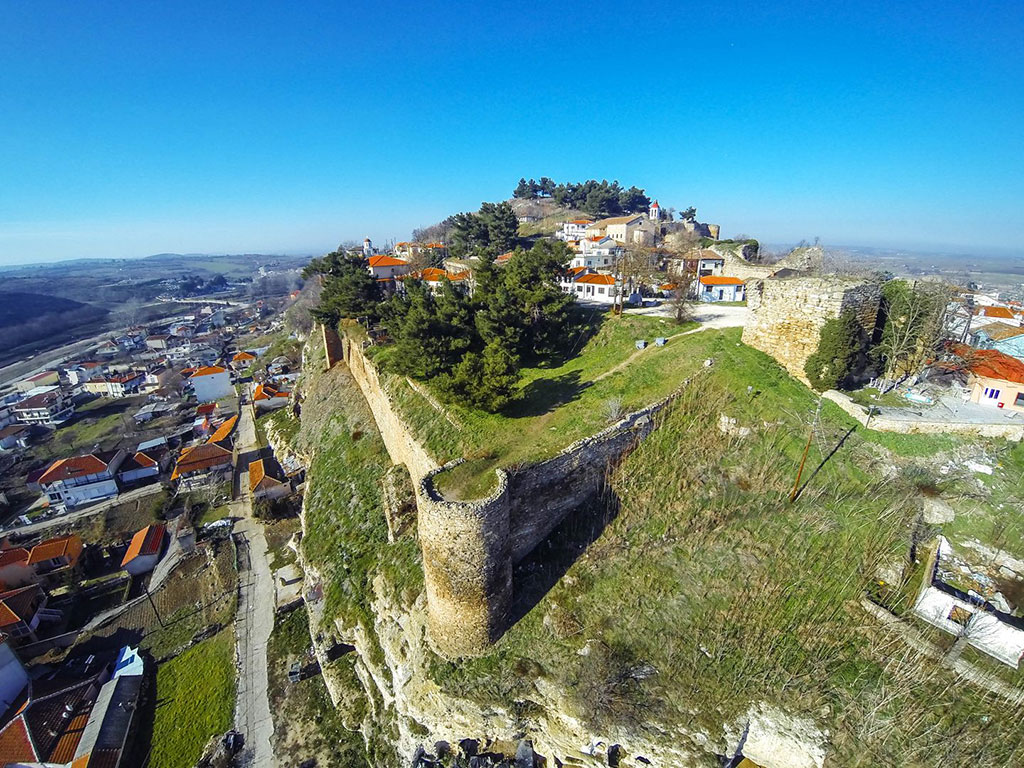
The Didymoteicho Fortress, is a hilltop citadel in the town of Didymoteicho, in Thrace, Greece. This is the most important castle of Thrace and one of the major Byzantine monuments of Northern Greece. It has been an important fortress since ancient times due to the strong fortification surrounding it and its strategic location. From the top of the hill, overlooks both the town of Didymoteicho, the Erythropotamos River and the road to Constantinople.
History
Various elements in the castle walls indicate there was a fortification in this location much earlier than the Byzantine period. The castle in its current form was built during the reign of Emperor Justinian. Later, in 751, the walls were reinforced during the reign of Constantine V. A final major reconstruction took place in 1303. During the Ottoman rule, the structures were not adequately preserved, and by 1848 the fortress was in a ruinous state. The castle suffered great damage from various invaders during the Byzantine and post-Byzantine years, but also by the Russians, who occupied Didymoteicho in the course of the two Russo-Turkish wars in 1829 and 1878.
The two central gates of the fortress are flanked by five-sided towers dating to the Justinian refurbishment. The West gate facing Erythropotamos river remains intact and contains a smaller gate next to a tower. Inside the castle there are scattered carved caves which were used as parts of houses, warehouses, water tanks or shelters. There are a number of Post-Byzantine buildings within the walls, notably the church of Aghia Aikaterini comprising tombs, the cathedral of Aghios Athanasios (1834), and the church of the Christ (1846).
The castle is accompanied by several legends, one of the most famous is that of the Forty Arches, and is where Charles XII, King of Sweden, is said to have been imprisoned by the Turks in a cave next to the 19th-century Cathedral of Saint Athanasios.
Source: Kastrologos
