













Μετάφραση 
Exploring the Ancient Greek Culture and History of Eretria
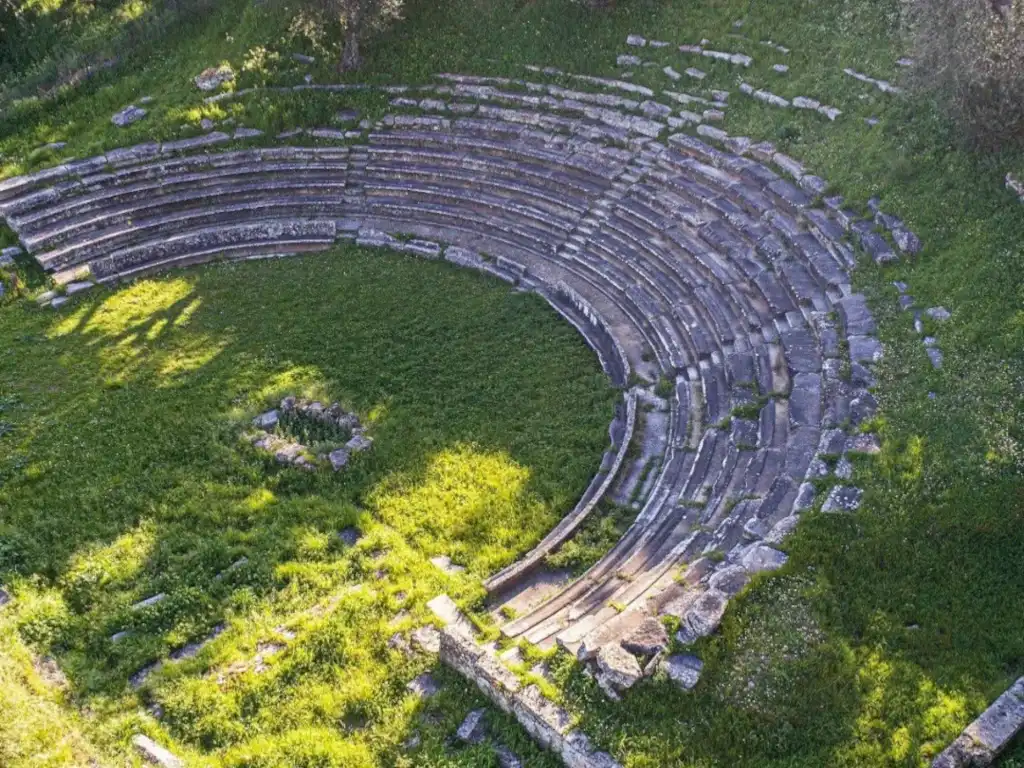
The Ancient Theatre of Eretria is one of most important monuments in the modern city. It is located in the western section of the town between the stadium and the gymnasium and is one of oldest theaters in the entire Greece. Its first building phase dates to the 5th century BC, probably followed the invasion of the Persians and the destruction of the city. It is a typical Hellenistic theatre with cavea (koilon), stage (scene) and orchestra. Of the first phase, only the foundation of the stage still survives. The present form of the cavea and orchestra belong to the second phase, dated around 300 BC. A striking fact is the construction of the cavea on an artificial hill, instead of the citadel’s slopes as in most Greek theatres.
Initially, the scene had five adjacent rectangular rooms and was at the same level as the circular orchestra. The theatre was shaped to a large extent at its peak and could seat approximately 6,300 spectators. The cavea comprised of eleven tiers, divided by ten staircases providing access to the seats. During the second construction phase, the orchestra was moved 8m north and was lowered by 3m. To connect the stage with the orchestra, an underground vaulted passageway was built, known as the “Charonian steps”. This passageway was leading through the scene to the center of the orchestra, allowing actors impersonating chthonic deities and the dead to appear and perform at the orchestra.
Following the destruction of Eretria by the Romans in 198 BC, the theatre was rebuilt with lower quality materials. The stage was extended with the addition of two wings and a protective grille was placed in front of the first row, to protect spectators during gladiatorial fights. Today, only the vaulted underground passage and part of the cavea survive while most of the stone seats have been looted. Excavation of the monument was undertaken by the American Archaeologist School, followed by restoration works by the local Ephorate of Antiquities. The Ancient Theatre of Eretria is a landmark of art, culture and history, with immense value for all Evia and Central Greece.
GPS Coordinates 38.3986, 23.7906


.jpg)