










Photo: © allovergreece.com
Μετάφραση 
A Complete Guide to the Ancient Theatre of Philippi, Kavala
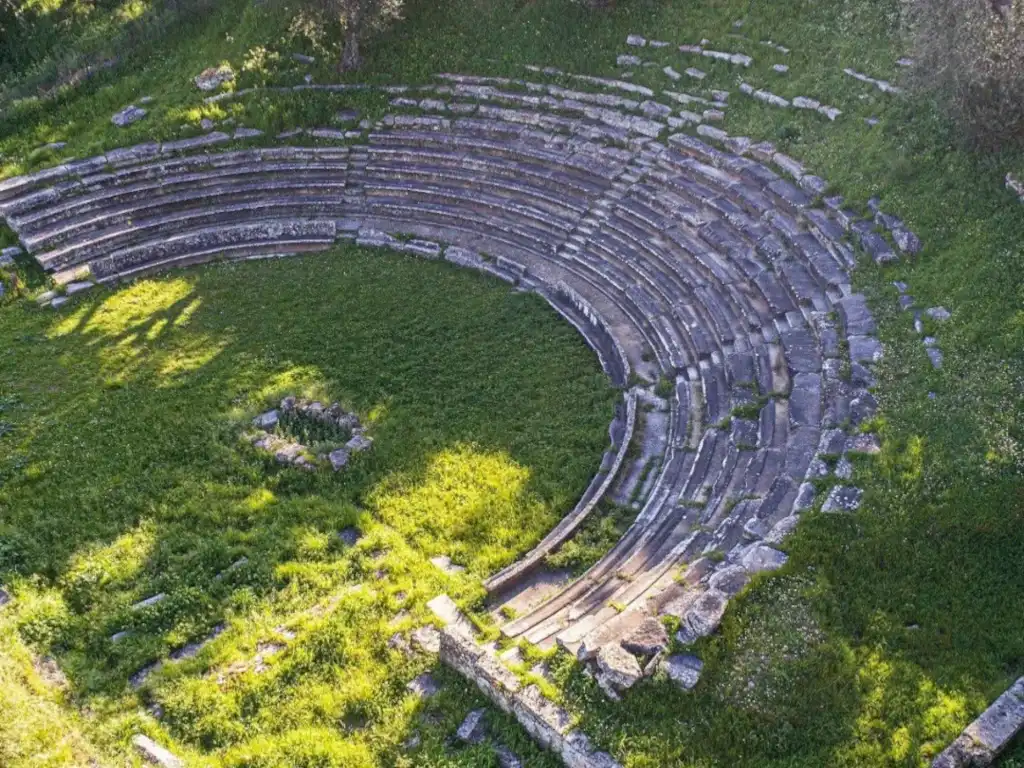
The Ancient Theatre of Philippi is one of the most important landmarks of the ancient city of Philippi, located in the regional unit of Kavala, in Eastern Macedonia. The city was originally founded in 360 BC as a colony of Thasos under the name Krenides. In 356 BC, King Philip II of Macedon conquered the settlement, fortified it, and renamed it Philippi.
The theatre stands on the southeastern slope of the acropolis hill, built against the city’s eastern walls for support. Its present form reflects a series of architectural transformations that mirror the long and fascinating history of Philippi.
From Philip II to the Romans
The theatre was first built in the mid-4th century BC by King Philip II. From this early phase, parts of the retaining walls of the cavea (the seating area) and the parodoi (entrance passages leading to the orchestra) are preserved. At that time, the orchestra—the central performance space—had the shape of a horseshoe.
During the Roman period, the theatre was expanded and adapted to new forms of entertainment. In the 2nd century AD, it was remodelled into a typical Roman theatre with covered side entrances, extended seating, and a grand stage building (scaenae frons) with three stories on the south side and two on the north facing the orchestra, which was paved with marble. Reliefs depicting scenes connected with Dionysus, the god of theatre, decorated the stage.
Transformation into an Arena
In the 3rd century AD, the theatre was converted into an arena for gladiatorial games and animal hunts. The stage front was demolished, the front rows of seating removed, and a protective wall with railings was built around the orchestra to safeguard spectators. A large underground chamber at the southern end of the orchestra was constructed to hold wild animals before their release into the arena.
Additional seating was added in the upper section (epitheatron), increasing the theatre’s capacity. Carved reliefs of Nemesis, Ares, and Nike—deities associated with combat and victory—adorned the western entrance.
Decline and Abandonment
By the 5th–6th centuries AD, the theatre ceased to function, reflecting the rise of Christianity and the decline of pagan spectacles. Parts of the stage were reused as workshops, and a devastating earthquake in the early 7th century AD led to its systematic dismantling. Stones from the theatre were recycled for new buildings in the city.
During the Byzantine era, workshops occupied the area behind the theatre. Later, under Ottoman rule, the cobbled road linking Kavala and Drama passed directly in front of the ruins.
Rediscovery and Restoration
European travellers documented the site as early as the 16th century, but systematic excavations began in 1921–1927 by the French Archaeological School. Work resumed in the 1950s under Greek archaeologist Dimitris Lazaridis. In 1957, the theatre hosted its first performance of ancient drama in modern times, reviving its original purpose after centuries of silence.
Further excavations and restoration continued through the 1970s and 1990s, in collaboration with the Aristotle University of Thessaloniki. Major conservation and reconstruction projects were completed in 2008, restoring much of the theatre to its present state.
Visiting the Ancient Theatre of Philippi
Location: The theatre is easily accessible via the Kavala–Drama provincial road.
- From Kavala: 16.6 km (approx. 25–30 minutes)
- From Drama: 22.4 km (approx. 25 minutes)
Today’s Experience: Each summer, the theatre comes alive again during the Philippi Festival, one of Greece’s oldest and most prestigious cultural events, featuring ancient drama, concerts, and modern performances.
UNESCO World Heritage Site: Since 2016, the archaeological site of Philippi, including its theatre, has been inscribed on the UNESCO World Heritage List, highlighting its outstanding historical and cultural value.
Why Visit the Theatre of Philippi?
The Ancient Theatre of Philippi is more than a monument—it is a journey through time, from Philip II’s Macedonia to the Roman Empire and the Christian era. Whether you are a history enthusiast, a theatre lover, or a traveller exploring Northern Greece, this UNESCO site offers a unique blend of heritage, culture, and live performance in an unforgettable setting.
Photo: © allovergreece.com
GPS Coordinates 41.01285, 24.28669
.jpg)