









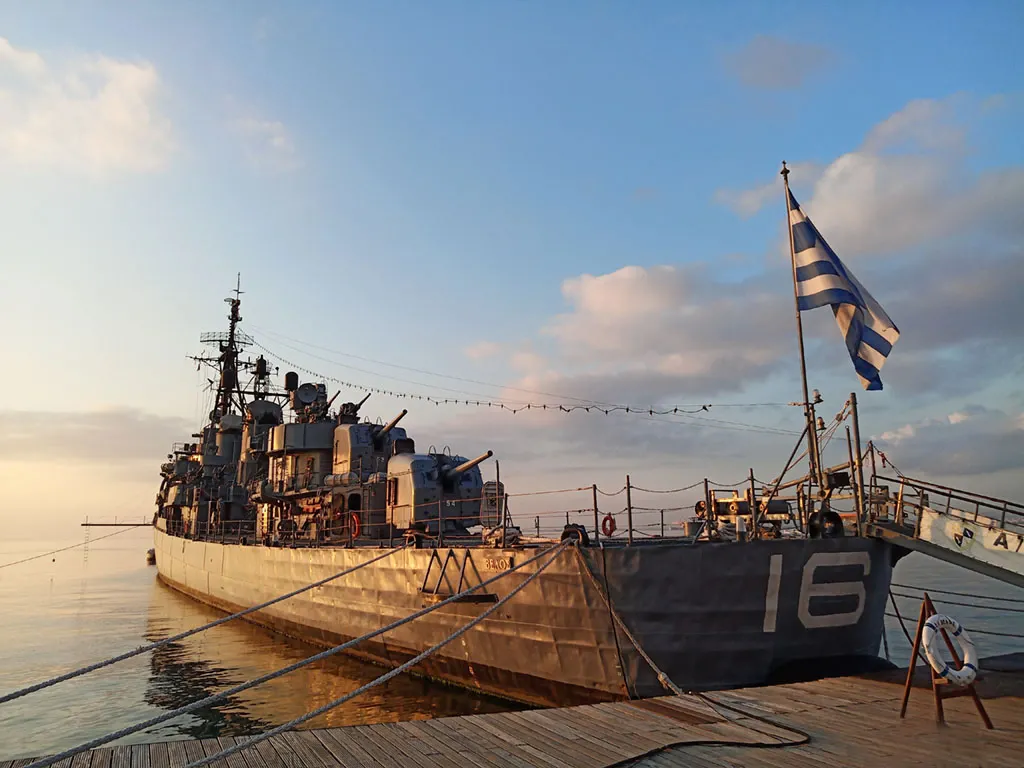
Photo: © ALLOVERGREECE
Μετάφραση 
Discover the Legacy of HS VELOS: Greece’s Historic Destroyer
HS Velos II (D-16) is a Fletcher-class destroyer. The ship was launched on June 3, 1942 by the Boston Navy Yard and was commissioned on 18 May 1943 by US Navy with name USS Charette (DD-581). It was one of the 175 warships of the same type, which were launched at that time. It was intended to fight in the open sea multiple threats. This type of destroyer was one of the most successful types of warships. Today, there are four ships of this type that still survive, three in the USA and one in Greece.
USS Charette participated in WW2, in the Pacific Ocean theater of operations, accompanying aircraft carriers and it took part in most of the allied naval missions against Japan. The most significant ones were the landing operations to take over the Marshall Islands, the Marianas operation, Hollandia Caroline and Okinawa. During those operations, it sunk the Japanese submarine I-21 on February night 4th-5th, 1944 and on June 15 of the same year spotted a 1,900-ton freighter and Charrette, with the destroyer Boyd intercepted and sank the Japanese ship, recovering 112 survivors. Charrette has received 13 battle stars for its World War II service.
Charette was taken out of commission and placed in reserve on March 1946 at San Diego USA and it was decommissioned on January 16, 1947. In 1958, it was modernized at the Long Beach shipyard in California and on July 15, 1959, it was transferred to the Hellenic Navy as part of the military aid provided by US to Greece. The ship was given the name "Velos" and sailed to Greece on October 25, 1959 under the commands of Greek captain G. Moralis HN.
On 25 May 1973, Velos under the command of captain Nikolaos Pappas, while participating in a NATO exercise and in order to protest against the dictatorship in Greece, anchored at Fiumicino, Italy, and refused to return to Greece. Commander Pappas was in a group of democratic officers who were loyal to their oath to obey the Constitution and planned to act against the junta. The captain, six officers and twenty-five petty officers requested asylum and remained in Italy as political refugees while the ship sailed to Greece a month later.
During the 32 years of service in the Hellenic Navy, it had 34 commanding officers. It participated in almost all national and NATO exercises as well in the Greek-Turkish crisis of the years 1964, 1967, 1974 and 1987. The HS Velos was disarmed on February 26, 1991, having sailed 362.662 nautical miles (671,576 km; 417,298 mi). In 1994, the ship was anchored at Poros Naval Base and on 14 December 2000, it was transferred to Salamis Naval Base for maintenance and restoration work in order to be converted into a visitable naval museum. From 26 June 2002 until 9 September 2019, it was anchored in the Naval Tradition Park at Palaio Faliro, Athens. Since 9 September 2019, Velos has been anchored on the waterfront of Thessaloniki, close to the city's Concert Hall and is open to the public.
Characteristics
The destroyer’s length is 376 ft 6 in (114.76 m) and has a beam of 39 ft 8 in (12.09 m). Its maximum speed is 35 knots (65 km/h; 40 mph) and it had a crew of 273 officers and marines. The ship has 2 sets of General Electric geared steam turbines and 2 propellers.
Visiting Hours
Velos is open to the public from Tuesday to Sunday from 10:00 to 14:00 and from 16:00 to 19:00. Ticket price is 2 euros for adults and 1 euro for students. Entrance is free for teachers of all levels, people with special needs, children up to 17 years old, unemployed, active members of the Armed and Security Forces and retired members of the Armed and Security Forces.
Photo: ALLOVERGREECE
GPS Coordinates 40.60082, 22.94906