










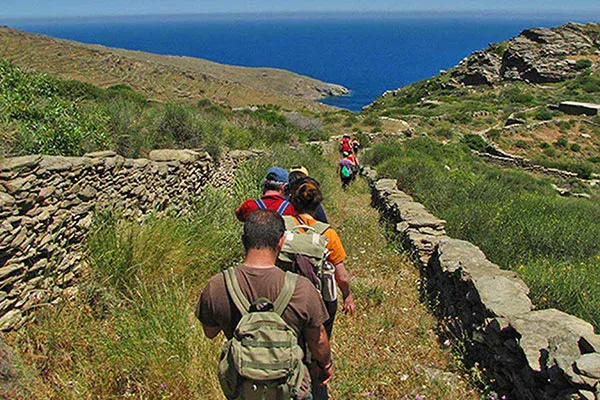


1. Mesta
Mesta is a medieval castle-village and one of the most beautiful "mastic-villages" (mastihohoria) of Chios. It is located at the south-west part of the island, 35 kms away from Chios Town and it has been designated a listed monument. Thanks to its fortress-like architecture, untouched by the hands of time, it is considered one of the most impressive villages of Chios.
Mesta was built during the Byzantine periode at a pentagonal shape. There are only two main entrances to the village. The houses, made of stone, are "glued" together in order to form a completely compact structure. Those built on the perimeter form a big wall, with no windows on the outside. The winding, narrow streets are like a big maze. During the old times, this peculiar architecture of the village served its defense against the pirates, who aimed for the precious mastiha, and later against the Turks.
There are two important churches in Mesta: Palaios Taxiarhis with an exceptional iconostasis (hand made facade carved of one piece of wood) and Megalos Taxiarhis, one of the biggest churches in Chios, standing where the main tower once was. The sunny Mesta square is a nice place to sit over a coffee. Mesta port is located 4km away from the village and it was recently restructured. Bigger ships can now enter the port. During the summer, it is used for the Lavrion - Mesta shipping route. For the food lovers, there are several restaurants at the port, with seafood dishes.
Protected Historical Monument - ΦΕΚ 37/Β/23-2-1946

2. Pyrgi Chios
Pyrgi is one the largest villages of south Chios, located 25 kilimeters away from the city. It is a castle-village, which still maintains its medieval character until our days. Pyrgi (variation of the word "tower" in Greek) owes its name to its tall tower, around which the village was built.
The architecture of the village is spectacular. Because of the enemy raids during the 16th century (mostly pirates), the village was built like a fortress: the houses, made of stone, are all "glued" together, the streets are narrow and there are some watchtowers inside the village. Except for the interesting architecture, the visitor of Pyrgi will be immediately impressed by one more thing, the "xysta" (scratches). It is a unique form of decorating the facades of the buildings of the village. You won't find this anywhere in Greece but here. Xysta are made of various black and white shapes. They start from the middle of the house doors and extend upwards, covering most of the facade. It is a style that is believed to be of Italian - Genoese - origin (sgraffito).
At the heart of the village lies the central square, where you can find some taverns and cafes. There are many churches in Pyrgi, both inside and near the village. At the west part of the central square you can find the biggest of them, dedicated to the Assumption of Mary. Not very far from the square, you can also find the church of Agioi Apostoli. This is a perfectly preserved Byzantine monument, a copy of the New Catholic monastery, with excellent frescoes of the 13th century. The local feast of the village is celebrated on the 15th of August.

3. Kalamoti
Kalamoti is an old, medieval village of Chios, located at the southeast part of the island. It stretches out on a fertile plain and is one of the 21 mastic villages of Chios. Kalamoti was built during the Genoese period (14th -16th century) and formed like a fortress in order to protect the local population against pirate invasions. The village was invisible from the sea, just like the rest of the mastic villages in the same area.
The main elements of the village’s layout were its closed quadrilateral shape, its uninterrupted defensive wall formed by the external walls of the outlining two-storey houses, the few and narrow alleys, the small public places and a multitude of churches. Some of the alleys are plain while others decorated with beautiful flowers. The houses are stone-built and most have carved doors. In the center of the settlement there was a tall tower that one can still see today. The village flourished till the devastating earthquake of 1881 that caused severely damage to the whole village. Elements of the medieval form and architecture are still preserved; however, many buildings have collapsed while others are in ruins. Due to its historical and cultural value, Kalamoti has been listed as a protected settlement by the Ministry of Culture since 1988.
The village is 24 km away from the city of Chios and is mostly inhabited by mastic farming families. Near Kalamoti is the Agriolopousena church with fine frescos of the 14th century, the ruined Zyvos Tower, the Byzantine church of Panagia Sikelia and the church of Profitis Elias, atop a hill offering a magnificent view. Just 3 km away, lies the seaside settlement of Komi with its cosmopolitan beach, one of the most popular on the island.

4. Lagada Chios
The picturesque seaside village of Lagada is located in the Bay of Kolokythia, in the northeastern part of the island, 17 km from the city of Chios. Built amphitheatrically on the slopes of a hill, features one or two storey roof-tiled houses with beautiful courtyards and narrows streets. Most of the inhabitants come from the abandoned village of Kydianta and are engaged in fishing or are seamen. Its little harbor attracts many visitors during the summer and offers nice views across the bay and the island of Oinousses. Actually, from the port you can visit Oinousses Island, taking advantage of the many scheduled daily crossings.
The village is crossed by the Krikelis river which forms a fertile area filled with olive groves and fruit-bearing trees.There is not much to see apart an old windmill on top of a small hill on the east side of the village. There used to be many such mills in the area, but only this one has survived to this day. The road to the village passes by the narrow water channel of Glyfos at the edge of the village. The channel is a safe anchorage for boats and local fishermen moor their small fishing boats there. In Lagada you cannot find any organized beaches, however there are some lovely beaches nearby such as Fanaraki Beach and Karydas Beach.
Lagada has some rooms and apartments to let, and many taverns and restaurants where you can enjoy fresh fish and delicious seafood overlooking the beautiful bay. A big feast takes place at the edge of the harbor every year on September 17th, in celebration of Agia (Saint) Sofia with local dances, drinks and plenty of food. Lagada is a peaceful little village ideal for relaxation and beautiful walks in the countryside and a place worth visiting during your stay on Chios.

5. Armolia Chios
Armolia is a medieval village of south Chios, located in a valley 20 kilometers southwest of Chios Town. There are about 442 people currently living in the village. The nearest villages to Armolia are Kalamoti, Pyrgi and Vessa. It is a typical medieval village with small stone houses, narrow side streets with arches and cobbled roads. Although a big part has been rebuilt, there are streets and corners, reminding its past. In the ancient years, the village was called "Hermolia", a name derived from the God Hermes. Another theory states that the name "Armolia" comes from the verb "harmozow" (Αρμόζω) - literally meaning "befitting".
Armolia is another one of the Mastihohoria (mastic producing villages). Apart from the production of mastiha, the residents have long tradition in making and decorating ceramics such as: pitchers, vases, jars, bowls and cups. Pottery is a tradition that was started decades ago and still goes on, thanks to the large amounts of clay that can be found at the bottom of a small lake located near the village. In Armolia you can find many workshops where you can buy beatiful decorated ceramic utensils.
Τhe church of Agios Demetrios dominates the central square of the village. Right next, stands the church of Panagia (of the Virgin), with one of the most impressive iconostases on the island, dated from 1744. On the top of the village, lies the monastery of Vretou, while up on Mount Likouri west of Armolia one can see the well-preserved Genoese Apolichnon castle. In this castle the Genoese housed the administrative seat of all the mastic villages in the area, known as “Mastihohoria".
.jpg)
6. Anavatos
Anavatos (literally means unassailable) is a medieval mountain village in the heart of Chios. Also known as the “Mystras of the Aegean”, it is perched high on a hill and offers breathtaking views and a tragic story, where women threw themselves off the sharp, steep cliffs with their children to avoid being kidnapped by the Ottomans. Anavatos played an integral role in the island’s history and particularly during the Greek War of Independence in 1821. During the Chios massacre, the village was sieged and destroyed by the Turks and unfortunately, it never recovered afterwards. It was finally abandoned in 1822 after the massacre and further damaged in 1881 after a big earthquake. Now it stands as a testament to the island’s rich past and is a remarkable example of a fortified town.
According to one theory, the village was founded by workers who arrived in Chios for the construction of Nea Moni, however the natural defenses of the site make it probable it was originally founded to control the island’s west coast during the period of piracy. Anavatos is located in a spectacular area of the island, high on a mountain with cliffs on most sides and there is only way up to it. The village was built entirely of local stone to camouflage it from pirates and the Ottoman invaders. The houses are all closely attached to each other and climb to the top of the hill. Near the only gate in the wall is an imposing building, the so-called “three-storey”. Walking the narrow pathways between the abandoned homes is very surreal. Most of the houses have turned to rubble but an effort to bring ruins back to life in recent times is ongoing. The Taxiarchis Church is one of the few buildings that has been preserved in this ghost town.
There are no inhabitants here except a mature lady, however in the summer a few more people come. There is a taverna serving traditional Greek food at the entrance of the village as well as an artist studio and gallery. Anavatos is one of the attractions that one should never miss. A walk up the hill to explore this ghost town is well worth the effort. The site is also beautiful from a distance so take some photos on your way up there. Bring your hiking shoes or at least comfortable covered shoes and discover what 200 years ago was a prosperous city. If you do take the trek out to Anavatos, very nearby is Avgonima, a semi-fortified medieval hillside village overlooking the Aegean Sea which is also worth a walk through.
This impressive village is an hour driving from Chios Town (20 kms) and not far from Nea Moni. Go early morning or later afternoon to avoid the heat. Keep in mind that this is not a curated site, which means that there is a sign at the outset warning you to climb at your own risk.
Distance Table
- Anavatos - Chios Town: 20,1 kms (32 mins)
- Anavatos - Avgonima: 4,7 kms (9 mns)
- Anavatos - Elinda Beach: 14,3 kms (23 mins)
Protected Historical Monument - ΦΕΚ 35/Β/2-2-1962

7. Volissos
Nestled on the northwestern side of Chios Island, about 40 kilometers from Chios Town, Volissos is a charming medieval village steeped in history and tradition. Built amphitheatrically on the slopes of a hill crowned by the ruins of a Byzantine castle, Volissos is the largest village in the Amani region and one of the island’s most authentic traditional settlements.
With its cobblestone alleys, stone-built houses, and timeless atmosphere, Volissos has preserved its character beautifully. Despite its historic charm, the village offers essential tourist amenities, making it a comfortable and rewarding base for exploring the lesser-known side of Chios.
Seaside Charm and Nearby Beaches
Just below the village lies Limnia, a small fishing port and marina—perfect for boat excursions or enjoying fresh seafood by the sea. The surrounding coastline is dotted with tranquil beaches such as Managros, Magemena, Gonia, Lefkathia, and Limnos, ideal for swimming, sunbathing, and relaxing in unspoiled natural settings.
Things to Do and See
Volissos celebrates its rich traditions with two major annual festivals: on August 6 (Feast of the Transfiguration of Christ) and August 15 (Assumption of the Virgin Mary). These lively events bring together locals and visitors for traditional music, dancing, and festive food under the summer sky.
Don’t miss the impressive Byzantine Castle of Volissos, known for its six circular towers and sweeping views over the Aegean Sea and surrounding plains. The hike to the top is a bit of a challenge, but the panorama is well worth the effort.
History buffs will also enjoy the Archaeological Collection of Volissos, housed in the 19th-century Konaki mansion. The exhibit highlights the legacy of Ariousios Wine, once celebrated by ancient Greeks as the “nectar of the gods.”
Nature Walks & Pilgrimage Sites
Nature lovers and hikers will find plenty to explore. A scenic walking trail starts just outside the village, leading through the lush Malagkiotis Valley, passing historical landmarks like the Church of Panagia Neromylon, traditional watermills, and the Chapel of Saint George of Vasilika, offering insight into Chios’ rural past.
Just 6 kilometers away lies the Monastery of Agia Markella, one of the most important pilgrimage destinations in the Northern Aegean.
Myths and Legends
Volissos is built on the site of an ancient town once known as "Volissos" or "Voliskos," where, according to the Greek writer Stefanos Viantios, Homer is believed to have lived. Some researchers even claim that the Battle of Frogs and Mice, a parody of the Iliad, was written here. In 412 BC, the Athenians landed in Volissos, defeating the rebellious Chians who had defected from the alliance, and devastated the area. Volissos was liberated, along with the rest of Chios, in 1912 during the Balkan Wars. After the Greco-Turkish War and the population exchange, 40 Greek refugee families settled in this historic village.
.jpg)
8. Olympoi Chios
Olympi is a medieval village of southwest Chios, 31 km south of Chios Town and 6 km from Pyrgi. It is one out of the 22 mastichohoria (mastic producing villages) where the mastic tree is cultivated, from which the well-known Chios mastic is extracted. The nearest village is Mesta at a distance of about 3.5 kilometers. The residents of Olympi are called Limpousi according to the local glossology. The village has been listed as a preserved monument as it is a typical example of a Venetian castle. One of the main characteristics of the village are the old stone houses, many of them impressively painted.
Olympi followed the principles of defensive / residential system organization implemented in the lowland Mastic area. At the four corners of the settlement, there are turrets. A central tower, almost 20 meters high, is the most well preserved of its kind tower on the island and served as a shelter for the residents. There is also a central gate (Kato Porta) and narrow cobbled streets with vaulted stone arches, which connected the houses. The settlement was built that way due to the fear of pirates and other enemy raids.
It is worth visiting the small church of Agia Paraskevi with the wooden carved iconostasis, a remarkable example of 18th century art. The church is located in the main square. Worth of viewing, is also the Bank of Olympi, a two-storey building with long narrow halls that survives from the old medieval period, in a very good condition.
During the carnival season, the event of Agas takes place at the village, along with other medieval villages of the area. The villagers appoint a man who is dressed as “Agas”, a strict judge of the Ottoman era. Most visitors and villages are tried and convicted by the Agas. The trials are based on humour and performance. The “Agas” event dates back to 1830 – 1840.
In short distance from Olympi is the cavern of Sykia, with its impressive decoration. It is a small cave, with greater depth than length, roughly 57 meters which offers a remarkable natural decoration of stalactites. The road ends at a deserted cape where the only human works are the medieval vigla and the small church of Agia Dynami that accompanies it
Protected Historical Monument - ΦΕΚ Δ 594/13.11.1978, ΦΕΚ Δ 189/02.03.1988
.jpg)
9. Vessa Chios
Vessa is an old, medieval village on the island of Chios. It is a typical example of a medieval community that has remained intact over the years, retaining its architectural and urban structure. Stone arches, picturesque alleys and stone houses, in harmony with its surroundings, travel the visitor back in time. Since the village was originally built as a fortress, the buildings stand very close to each other. Vessa as a genuine medieval castle village has taken the elements of medieval architecture as well as influences from the Genoese. Typical examples are the village chapel and the central tower in the old square of the village.
Vessa has been standing in the same place since the 10th century and its architecture is influenced by the threat of the pirate attacks during the Medieval times. Many of the houses in the settlement are now half-ruined and several of them are uninhabited. Vaulted passageways, gates, and even a substantial part of the original medieval fortress tower still stand, together with 19th century buildings. The village had a tower and it was surrounded by a wall.
It worth visiting the church of Agios Dimitrios to admire the carved image on wood. Among the village churches are Panagia and Panagia Petrousena, which is considered to be the most ancient church of Chios, according to the locals.
The picturesque village lies in the center of a valley. It was named by the word “Vissa”, which means “valley” and identifies its location. Vessa is located in the south part of Chios, around 19 km from Chios town. It is one of Mastic villages and one of the oldest villages on the island of Chios.
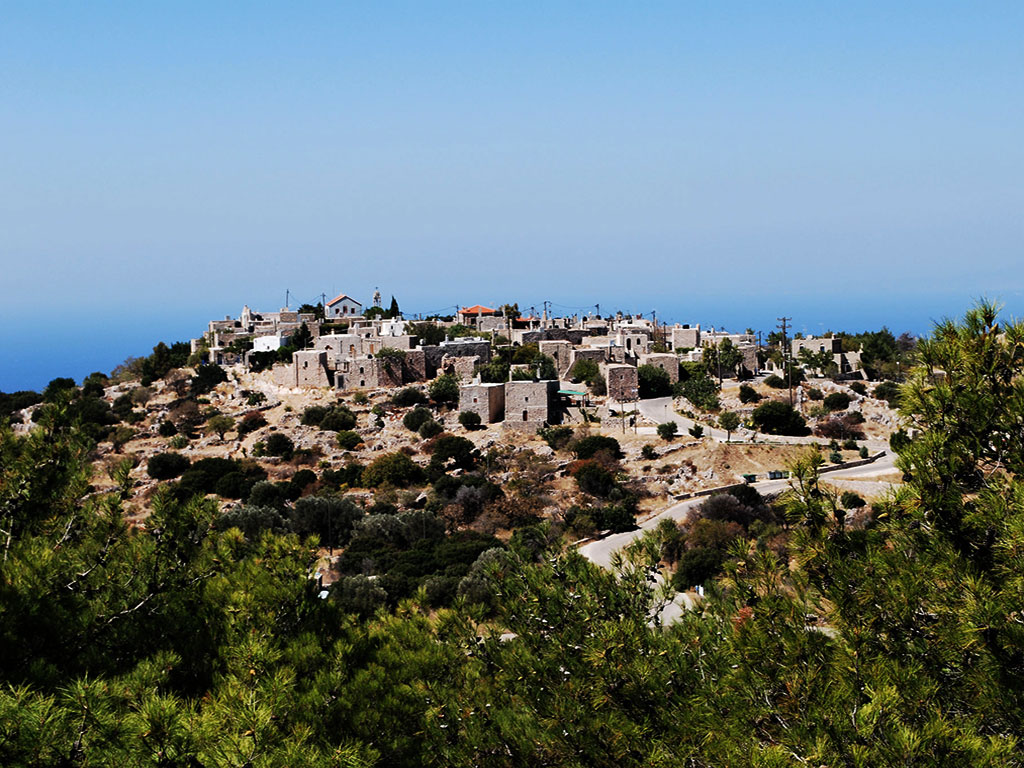
10. Avgonima Chios
Avgonyma is a village of western Chios, about 16 kilometers from the island's capital. It is a mountain village where the few locals are engaged in agriculture and beekeeping. The village that lies on a rocky hill surrounded by the pine forest of Provatas, overlooks the endless blue of the Aegean Sea. During sunset, the view of the Aegean and the neighboring island of Psara is amazing.
Avgonyma as well as the neighboring village of Anavatos is a medieval fortified type village that according to local tradition was built by the same workers who built the New Monastery in the 11th century AD. and then settled on the island. The houses are built of stone, have small windows and are very close to one another, to be protected from pirate raids during the Middle Ages. It was almost abandoned in the 60's and thus was saved by potential urban type reconstruction. Even today the houses retain the architecture of the past and most of them been restored with respect to local architecture.
Small streets lead to the village square where the parish church (the "village church"), is located, honored to Agios Georgios (St. George). On the night previous to Resurrection day, a huge fire is made outside St. George ’s church on the main square, on which Juda’s dummy is burnt. Lots of visitors come to the village on the night to see the fire and congregate at the Church. There you can also find some traditional taverns serving delicious local food such as lamp, fried balls with herbs and chickpeas. Other old churches and chapels worth visiting, include Panagia and Agios Isidoros. North of Avgonima lies the medieval village of Anavatos and in the south the village of Lithi. East of the village stands the New Monastery, one of the most important and historic monasteries on the island.

11. Vouno Chios
Situated 19 km southwest of Chios Town, Vouno is a typical example of a medieval village. The village is built like a castle with the outer walls of the houses forming the castle’s external wall. Vouno took its name from the rock on which it is built (vouno is the Greek word for mountain) and thanks to this mountain the village survived the big earthquake of 1881 which caused severe damages to other villages on the island. Vouno has retained its original architecture form with arched passages and narrow alleys that resemble to a labyrinth. According to travelers of the past centuries, once the village had almost 500 residents, a fortified tower and several old churches as well as two gates for the residents to enter and leave the settlement which were open during the day and closed at night. Today, the village has only 170 residents mainly engaged in cultivation. This little village offers lots of photo opportunities and a visit can be combined with swimming at one of the extraordinary beaches in this area.
Photo: @chios_text_image_
