











1. Marpissa Paros
Marpissa or Tsipidos as its former name is, is a picturesque village with whitewashed houses and cobbled alleys, built on a hill,19 km from Parikia. Most of the houses were built in the 16th and 17th century. At the center of the hill there is the dominating church of Metamorphosis (the Transfiguration of Jesus), of byzantine style. One of the most characteristic pictures of Paros is the one with the four windmills in the central square of Marpissa. Nearby paths are ideal for walks to places of magnificent natural beauty, to old monasteries and churches. The village square is the starting point of such a path that leads to the monastery of Agios Antonios (St. Anthony) with is a very nice view of Paros and the surrounding islands. In Marpissa there is a Byzantine gallery and the sculpture museum of Nikos Perantinos. The sculptor was Parian origin from the village of Marpissa and donated 192 sculptures to his village.
From Marpissa you can easily reach plenty of beautiful beaches on the eastern side of the island, Piso Livadi, Logaras, Chryssi Akti and Drios beaches. An exceptional experience in Marpissa is the Easter with religious customs and a big Greek feast. Marpissa considers to be one of the most beautiful villages of Paros.
.jpg)
2. Parikia Paros
Parikia is the capital of Paros Island. It is also the main port and a famous tourist destination. Parikia is located on the western coast of the island and occupies the site of the ancient capital Paros. Ferries depart from the port town to the neighboring Cycladic islands and this makes it a great place to be based on the island. Most of the boat and sailing tours also start from here. In winter, it is a sleepy small town, but it comes alive in summer when filled with thousands of tourists from all over the world.
There is a quaint old town with sugar-cube-like houses decorated with blue-painted shutters, small hidden churches with blue domes, whitewashed windmills and lots of quaint little alleyways and side streets with loads of history. Lined with bougainvillea they are absolutely beautiful and create great photo opportunities. The old town is a great place to walk around in and one of the loveliest villages in the Cyclades. Amongst the alleys you can find small boutique shops, some of the best restaurants and many cute cafés. Restaurants and tavernas also line up the promenade and offer a seafront dining experience looking out over the Aegean Sea. With so many of them based on the water’s edge, it can be hard to make a decision where to dine.
There is enough to do and see in Parikia to keep you busy or you can just chill. This is where you will find interesting historical monuments and points of interest such as the 4th century Byzantine church of Panagia Enatontapyliani (Our Lady of a Hundred Doors), one of the most important and best-preserved Christian churches of Greece. Near the church is the Archaeological Museum with remains from a period spanning from the Neolithic to the early Christian times. Along the waterfront you will find an ancient cemetery dating from the end of the 8th century BC. However, one of the first things you will see on your arrival is a photogenic whitewashed windmill. It is the landmark of Parikia and a nice place to watch the sunset. Parikia offers visitors the opportunity to visit the Frankish Castle, a ruin leftover from the days when the Venetians had control over Paros, remains of the Archaic Temple of Athena and many quaint old churches such as Panagia Stavrou, Agia Anna, Taxiarchis and the church of Agios Konstantinos with great views out over the ocean.
Parikia is within easy walking distance of a number of nice beaches such as Livadia Beach near the Old Town, Souvlia Beach and Martselo Beach. They all have clear water and are fully equipped with sunbeds and umbrellas. Parikia is a popular town to stay at in Paros and there are plenty of accommodation options, yet if you’re planning on coming to Paros around August 15th, book well in advance because that day hordes of pilgrims come to Paros to celebrate the name day of the Panagia (Virgin) and take part in the big feast which is organized at the church of the Panagia Ekatontapyliani. If you are planning on seeing the entire island by using the buses or the excursion boats, your best bet is to base yourself in Parakia. Its central location makes it an excellent location for exploring the rest of the island.
Protected Historical Monument - ΦΕΚ 183/Β/16-3-1967

3. Naoussa Paros
Naoussa is the second largest village of Paros and it is located in the northeastern corner of the island, 11 kilometers from Parikia. It is a popular tourist destination with an exciting nightlife and one of the most beautiful fishing villages in Greece, having maintained its original character. The traditional, whitewashed houses with the flowers and the quaint stone-paved streets give Naoussa an otherworldly sort of beauty.
It has a safe harbor for fishing and sailing boats and one of the largest fishing fleets in the Cyclades. The old fishing port is one of the most beautiful corners of the Aegean Sea and the spiritual center of Naoussa. That is the spot where you will find many cafes, which during the evening hours become bars, and fish restaurants, which in the past had the important role of fishermen's warehouses.
Naoussa was built around the port during the Byzantine period and has played an important role since the time of Komnenos. It was fortified with a wall that ended in the castle. Even today parts of it are preserved and are of great historical and archaeological interest. The castle was built by the Venetians while nearby is the church of Agios Nikolaos protector of sailors and fishermen. In its square is the church of Panagia Pantanassa while on the hill of the settlement is the church of the Assumption of the Virgin.
In short distance there are several remarkable monasteries with ornate iconostasis, frescoes and original architectural styles. These include the historic Monastery of Agios Athanasios in Protoria, whose cells after renovation have been converted into a Byzantine museum where exhibits wood carvings, sculptures of the Byzantine and Venetian period, many cult utensils, icons of Parian and Cretan 13th and 12th century. Some of the most important are the "Prayer" (15th century), the "Apostasy" (16th century) and the "Virgin Mary holding the baby" (also the 16th century), as well as the only hagiography section that survived from the Byzantine church. It is noted that this monastery during the Turkish occupation served as a school for the Catholics.
In the Folklore Museum of the village there are traditional costumes (men and women) not only from the Cyclades but also from various other areas of Greece created by the dance folk group "Naoussa Paros", as well as the folklore collection of Dr. Othonas Kaparos which includes a library, a rich photographic archive and some archeological finds. Other sights are the Mycenaean palace of 1200 BC. found in Koukounaries and archeological findings from the excavation there are exhibited in the Archaeological Museum, the Early Cycladic cemetery (Plastira) where many figurines and tombs of special interest have been found, which according to their characteristics date to the Early Cycladic period and the islet of Agia Kali on which the Russians with their leaders Orloff had set up their headquarters when they occupied the Cyclades in 1770.
Near Naoussa there is the beautiful beach of Kolimbithres with its colorful rocks and strange formations. Other beautiful beaches nearby is Santa Maria, Piperaki, Piperi, Monastiri and Langeri.
During the summer, many festivals and events are organized, such as the fish festival and the Kursari night, on August 23, which represents the looting of the village by pirates and is accompanied by the burning of sparklers and a big party with lots of wine and seafood.
.jpg)
4. Lefkes Paros
Lefkes is a traditional village, built in the heart of Paros. It is the highest and the most verdurous village, built at an altitude of 250 meters on a hill overgrown with pine trees. It is at a distance of 10 km from the capital of the island, Parikia. Lefkes was the first capital of Paros. Its name comes from the many poplars that used to exist in the area. Apart from many churches, in the village there are also some of the last surviving windmills of the island.
It is a picturesque village with typical Aegean houses built amphitheatrically, with whitewashed cobbled alleys and old washhouses that are still used by certain housewives. The main street is called Ramnos. Among the neoclassical buildings that will accompany you on your walk on this street there is also the House of Literature and the Museum of Cycladic Folklore. There are also some taverns serving traditional food. Vehicles are not allowed in the village. It is worth visiting Lefkes and walk in the narrow streets, with the arches, among the whitewashed houses with the colorful flowers in the yards and on the windows. The meeting point for the locals is the central square, near the monument of Heroes where they meet to talk or to drink a coffee.
The most famous landmark and symbol of the village is the church of Holy Trinity. It was built in 1835 with marble from Paros and has been declared as a protected monument. Other well-known churches are the monastery of Agios Ioannis Prodromos and the churches of Agia Kyriaki and Panagia Ypapanti. There are lots of small churches scattered throughout the village, many of which date from the 17th century.
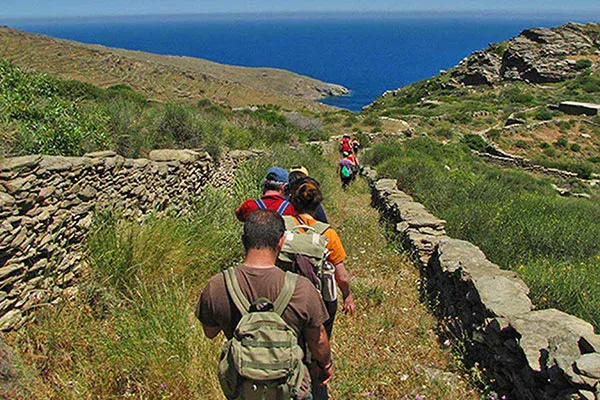
In the 1970s the village experienced a great desolation due to astyphilia when many residents left the island and moved to the capital city, Athens. In recent years, however, with the development of tourism, many have returned back. At the end of August, one of the biggest festivals of the island, the feast of Karavolas takes place in the village. The festival lasts till the first morning hours since there is also traditional music. At the festival there is plenty of food served such as karavolas, a large local snails, traditional cheeses, chick peas in the oven and of course lots of wine. The festival symbolizes the "summer farewell" and is organized by the Cultural Association of Lefkes. The Byzantine road starts from Lefkes, a marble-paved path over 1,000 years old and 3.5 kilometers long, which runs parallel to the carriageway and connects Lefkes with the village of Prodromos.
Near Lefkes is the highest peak of Paros, that of Agioi Pantes, at 755 meters high, from where the view is really stunning. The village is a tourist destination and attracts many tourists during the summer months.

5. Prodromos Paros
Prodromos is a picturesque, traditional settlement of Paros, located on the east side of the island, about 16 kilometers from Parikia. The area where the village is located is purely rural, with many orchards, streams and livestock production, mainly cattle. Its initial name was Dragoulas, but in 1953 took its current name from the church of Agios Ioannis Prodromos, built in the village at that time. The church celebrates on June 23, day on which one of the most important festivals of the island takes place.
At the entrance of the village is the church of Agios Spyridon which is connected by an arch with the church of Agios Nikolaos. The arch with the bell tower above it, prevents the entry of vehicles in the settlement, while it is its main entrance. The whitewashed houses with the courtyards full of flowers, the alleys with arches and the traditional coffee shops with the traditional home-made delicacies give a unique color to the village.
The village is crossed by the Byzantine path with the ancient marble slabs that connected the village of Marpissa with Lefkes in the old days. The marble path, over 1000 years old which runs 3.5 kilometers parallel to the modern road, is drowned in olive groves and vineyards and is one of the village's main attractions. From Prodromos the nearest beaches are Molos, Kalogeros and the beach in Tsoukalia.

6. Kostos Paros
Kostos is one more picturesque village of Paros. A typical Cycladic village with whitewashed cube-shaped houses, numerous churches and narrow alleyways. It is located at an altitude of 160 meters and offers panoramic views to the bay of Molos and the opposite island of Naxos. The village dates back to the years of Venetian rule. As to the origin of the name, there are many different versions.
There are several worth-visiting churches in Kostos such as the parish church of Agios Panteleimon the patron saint of the village, situated next to a small grove in the center of the village. A bit further you can find the churches of Agia Marina and the church of Resurrection. Among the most important attractions, are the old wash places that now have been renovated, located on the outskirts of the village. Kostos is the birthplace of Athanasios Parios, a writer who developed a remarkable writing activity and who was also a great teacher in many regions throughout Greece during the preparation of the Greek revolution. His house has been preserved and is open to the public. At the entrance of the village there is a monument dedicated to him as a symbol of gratitude.
Despite its size, three major feasts take place in Kostos every summer. The first in memory of Athanasios Parios (June 24), the second of Agia Marina (July 17) and lastly, of Agios Panteleimon (July 27). Kostos is located on the route from Parikia to Lefkes, 7 km from Parikia, the capital of the island. If you visit the village do not miss to try Souma, the traditional drink of Paros accompanied by local delicacies.

7. Piso Livadi Paros
Piso Livadi is a small beach resort of Paros with a lovely harbor and nice views of Naxos in the distance. It is a very attractive place with whitewashed houses with blue painted doors and shutters. At its picturesque harbor there are several cafes and restaurants with panoramic views of the port, the village and the beach, where you can try delicious Greek food while enjoying a nice cold ouzo. Piso Livadi has its own fleet of fishing boats; therefore, you will enjoy fresh seafood in the local taverns. The idyllic port is well protected from the winds and offers a safe anchorage for small fishing boats and yachts. It is linked by boats to Naxos, Ios, Amorgos, Mykonos, Santorini and other islands, offering the opportunity of various short excursions and daily cruises.
The beach is sheltered with many trees for shade. It has fine sand and the water is calm, clear and shallow which is good for kids and families. Behind the beach there is parking space and a bus stop serving the rest of the island. South of Piso Livadi one can find many superb beaches such as Logaras and Pounta. North of the village are the equally beautiful beaches of Molos and Kalogeros. From Piso Livadi, you can walk along the Byzantine trail to Lefkes or you can visit the traditional villages Marpissa, Prodromos and Marmara. There are many rooms and studios to rent in this beautiful village with marvelous views of the small and picturesque port. There are also some tourist shops, a bakery and a mini market. The scenic coastal settlement is situated at a distance of 18 kilometers southeastern to the town of Parikia, on the eastern coast of the island.
